Unibest 优贝德
07TraditionNLP logical levels · Positive psychology · Cognitive-behavioural tradition·10 viewpoints

Inner Growth

Only those who look inward can see the way outward clearly.

Most problems in the outer world have roots in the inner one: unclear goals, conflicting beliefs, emotional friction, runaway desire. This discipline collects workable tools for inner management — from six-level planning and the scale of consciousness to the causes-and-conditions of emotion and the arithmetic of happiness: separate what can be controlled from what cannot, then invest attention where it compounds.

Public viewpoints10 viewpoints

Six Logical Levels: The Upper Three Determine the Lower Three

Before working on capability and action, align mission, identity and beliefs — the upper three levels determine the lower three.

The six logical levels split a person's situation into: mission (relation to the world), identity (who I am), beliefs and values (what I hold true), capability, behaviour, and environment. The upper three run on the subconscious and answer "willing or not"; the lower three answer "able or not" and "supported or not". The upper three determine the lower three — will outweighs skill, so align it first. Most people grind only on capability and behaviour, which is treating symptoms.

The model is isomorphic to 5W2H and to the Golden Circle: ask why first, then how, then what. Operationally: set goals the SMART way, iterate on a PDCA loop, and when results fall short, look inward first. When direction and energy align, capability and external support begin to resonate.
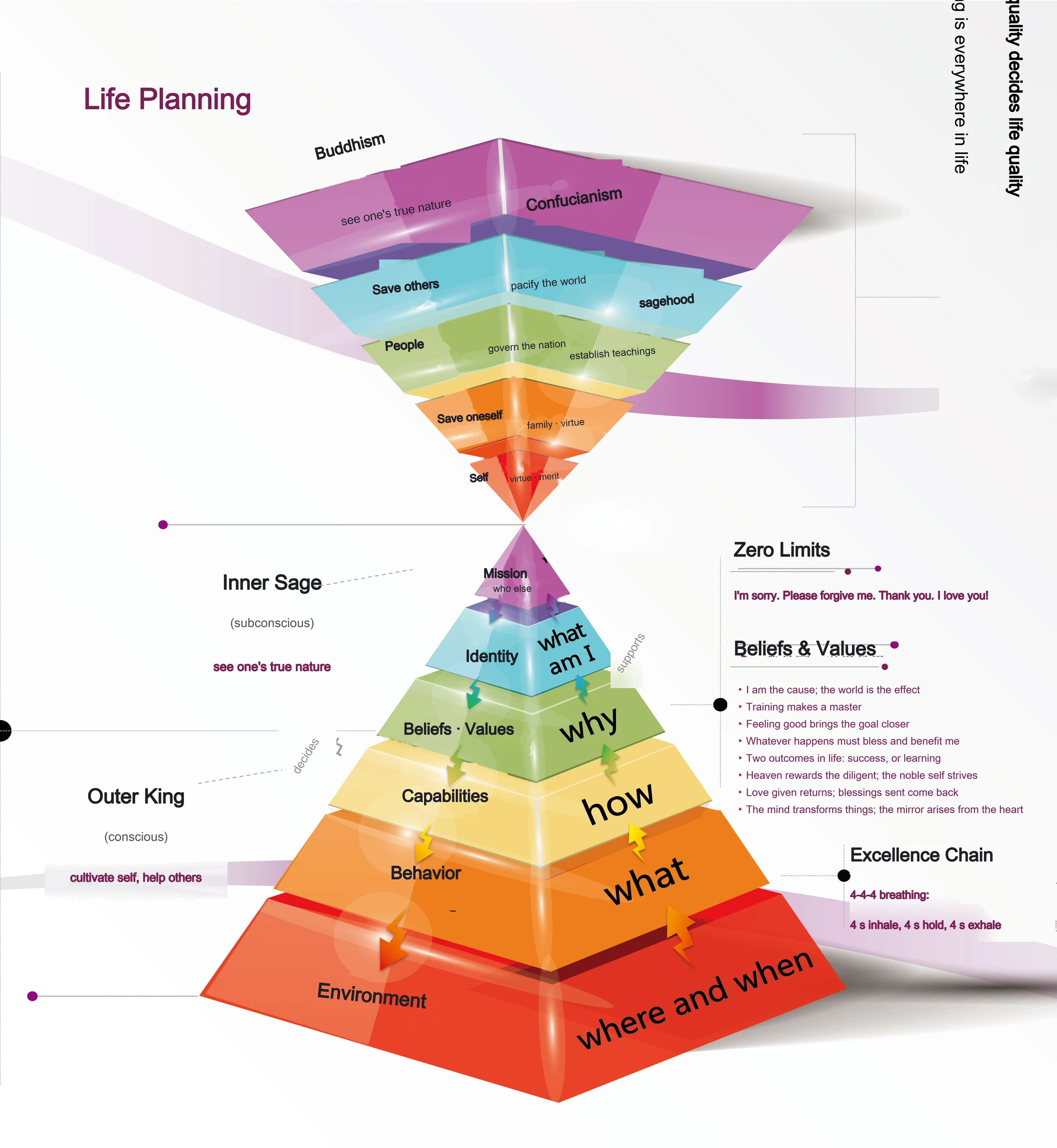
Life Planning — hourglass and pyramid (course diagram)

Ten Questions: Working Backwards From the End

Ten questions running from "what value can I create" to "is this truly what I want" — a single pass through mission, identity, beliefs, capability, action and resources.

The ten questions form one causal chain: what value would the ultimate version of my work create? What do I truly want? What kind of person attains that value? Where do my talents meet the world's needs? What beliefs would support that mission and identity? What do I profess? Which capabilities are indispensable? What must I do, repeatedly, to build them? Which resources exist, which are missing, how to obtain them? And finally, back to felt sense: is this truly what I want?

Questions one to four work backwards from value to mission and identity; five to eight turn belief into capability and action; nine and ten close with a resource audit and a gut check. It is a routine worth re-running yearly — the answers change; the order (end first, step by step, present-minded, integrated) should not.

Levels of Consciousness: 200 as the Divide

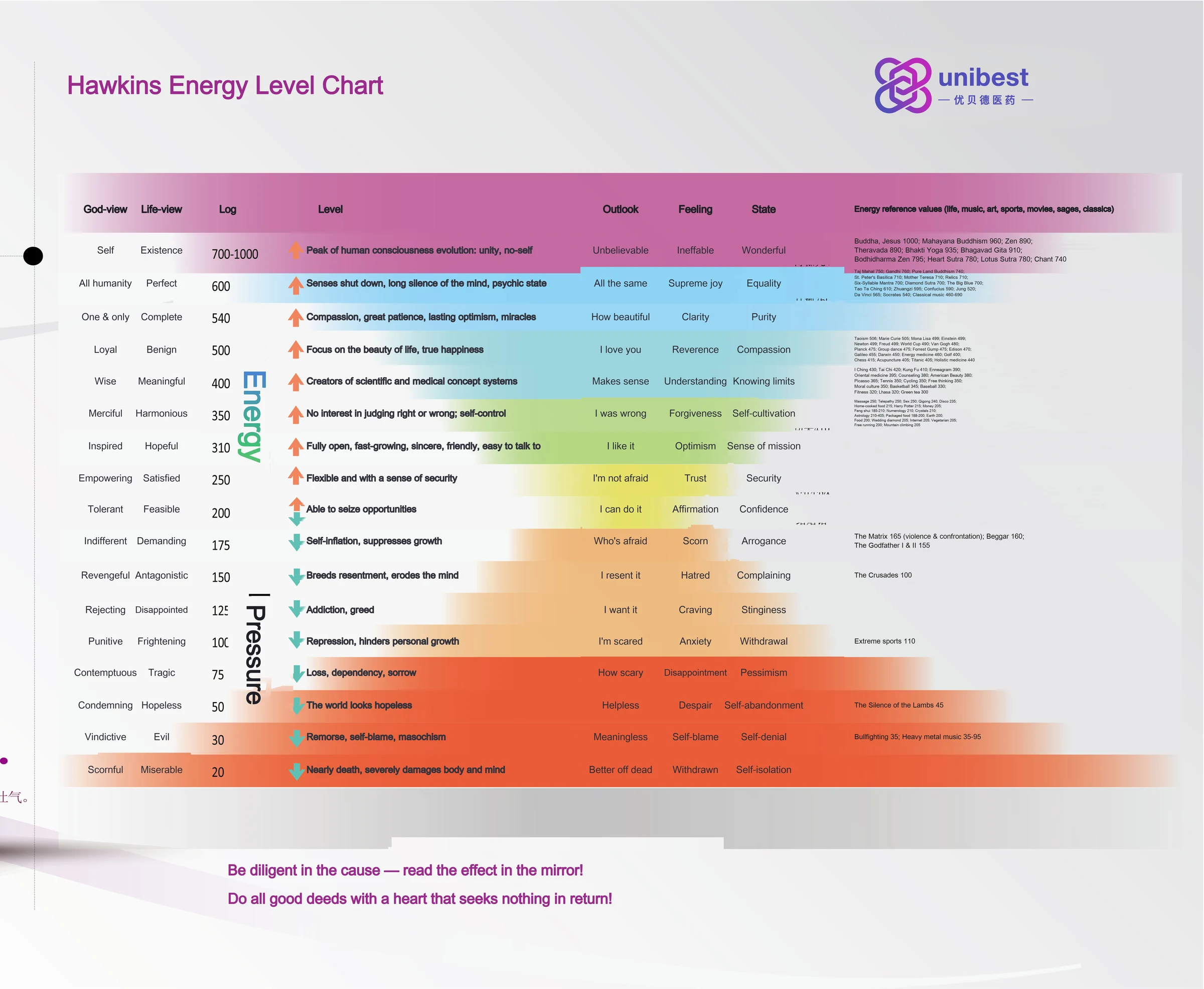
Levels of consciousness are a mirror, not a judging tool — above 200 lies the positive range, and an organisation grows only as far as its energy ceiling allows.

David Hawkins' Power vs. Force maps consciousness onto a scale: 20–30 shame, 50 apathy, 75 grief, 100 fear, 125 desire, 150 anger, 175 pride, 200 courage, 250 neutrality, 310 willingness, 350 acceptance, 400 reason, 500 love, 540 joy, 600 peace, 700 enlightenment. Two reminders: emotions have no moral polarity — grief, once faced, begins to transform; and the scale is for looking at yourself, never for measuring others.

Mapped onto organisations it becomes a sobering model: founders at 350–400, executives at 310+, middle managers at 250+ (unshaken under pressure), staff at 200+ (persistent). An outfit that strains past thirty people, or stalls at two hundred for years, usually has a strategy problem only in appearance — in substance, it has an energy-ceiling problem: organisations never outgrow the level of their key people.

Hawkins Energy Level Chart (course diagram)

Six Mirrors of Self-Knowledge

Knowing yourself is among life's core assignments — six models, each illuminating one layer: needs, thinking, growth position, deep values, blind spots and self-management.

Six mirrors: Maslow's hierarchy illuminates real needs; the six logical levels illuminate where you are thinking from; the growth-circle model locates you inside comfort, fear, learning, growth or freedom; the iceberg model exposes feelings, beliefs and yearnings beneath behaviour; the Dunning–Kruger effect marks what you don't know you don't know; and the personal business canvas treats you as a company — customers, value proposition, cost and revenue.

Any single mirror can flatter you: needs alone rationalise desire, strengths alone hide blind spots. Run all six and cross-check — self-knowledge is not a single epiphany but a repeatable examination programme.

Cause, Condition and Consequence of Emotion

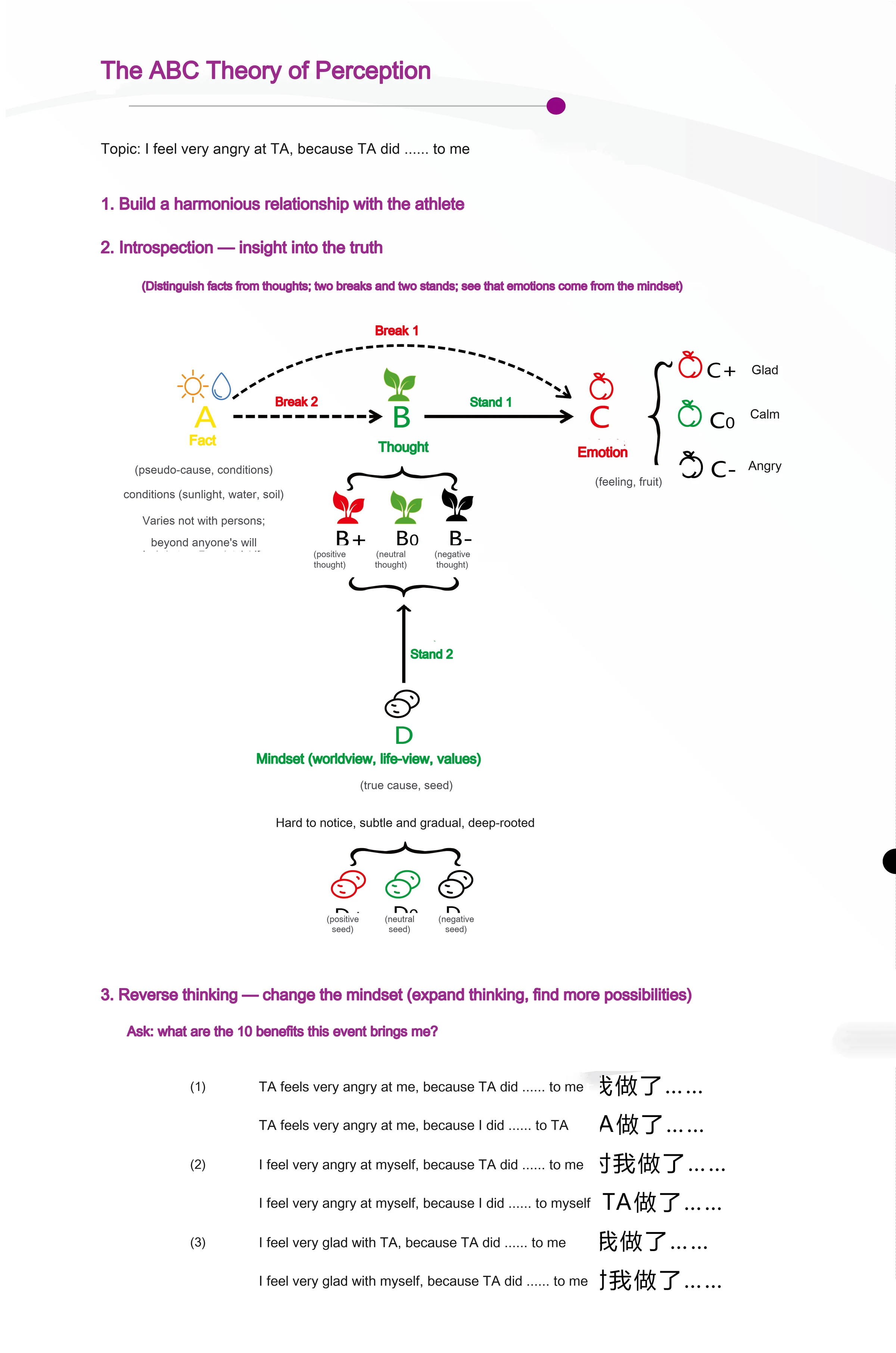
Emotion arises not from facts but from thoughts; thoughts arise not from others but from one's mental models — one finger points at them, four point back at you.

Emotion ABC: A is the event, B the belief, C the emotional consequence. Most people write the causality backwards — "he did that, so I am angry." Three moves expose it. First, separate fact from thought: rain is a fact, "what awful luck" is a thought; facts do not vary by person, thoughts do. Second, trace thoughts to mental models: given the same material, everyone reads it from a different angle, because the deep, unexamined assumptions differ. Third, distinguish cause, condition and consequence: the seed in one's mental model is the cause; the other person's act is merely the condition; the emotion is the fruit. Mistaking condition for cause is the cardinal error.

Once seen, two practices follow. Inquire inward: "I am angry at X because..." — is that causal claim actually true? Could the other person have been under crushing pressure? Reverse it: flip subject and object, swap the emotion word — not to console yourself, but to break the fixed neural pathway and widen the space of possibilities, until one truth stands clear: only by turning attention to one's own thoughts does command of one's fate return.

The ABC Theory of Perception (course diagram)

Three Strata of Belief: Where REBT and CBT Enter

The entry point for changing emotion is belief: dispute irrational beliefs directly (REBT), or descend from automatic thoughts to core beliefs (CBT).

Two therapies, one ancestry, different doors. REBT (Ellis) enters at belief: negative emotion follows irrational beliefs with three signatures — demandingness (must, should), overgeneralisation, and awfulising. CBT (Beck) enters at automatic thoughts: emotion, behaviour and cognition form a continuum, and cognition has three strata — automatic thoughts (fleeting), intermediate beliefs (attitudes, rules, assumptions) and core beliefs (ultimately: am I lovable? am I capable?). Automatic thoughts are generated by the strata beneath, so the fleeting is easiest to fix and the core hardest.

The practical tool is ABCDE: catch the reflexive interpretation (B) after the event (A), observe consequence (C), dispute it (D) — what other evidence, what other angle; accept the unchangeable, change the changeable — then energise new action (E). Useful substitutions: "must" becomes "prefer", "always/never" becomes "this time".

Fast and Slow Thinking: The Bill for Intuition

Most of the time we run on intuition — the first act of good decision-making is knowing when to slow down and summon the deliberate system.

Kahneman's Thinking, Fast and Slow: System 1 is fast, automatic and always on; System 2 is slow, effortful and only roused when System 1 stalls. The division of labour is usually efficient — but System 1's outputs (impressions, intuitions) do not always reflect reality, and the lazy System 2 often rubber-stamps them. Hence a stable catalogue of biases: mere-exposure (familiarity mistaken for truth), confirmation, halo, framing ("90% survival" equals "10% mortality"), anchoring, small-sample overconfidence, availability, loss aversion, endowment, peak-end.

Three workable counters: slow down at high-stakes moments and summon System 2 deliberately; bring in outside views — spotting others' errors is far easier than spotting one's own; and run the premortem — assume the plan failed a year from now and spend ten minutes writing the post-mortem. Intuition is not the enemy; unexamined intuition is.

Framework Thinking: No Overlap, No Gaps

The quality of reasoning is bounded by the quality of the frame — with MECE frames, thinking becomes both exhaustive and structured.

MECE is two rules: no overlap, no gaps. Real exhaustiveness comes from completeness thinking — if success needs A+B+C+D, missing one means no success. Example: sustained success = strategy × organisational capability; capability splits into willingness × ability × permission — mindset (culture, pay), ability (grow, hire, retain, exit, borrow) and governance (structure, systems, resources), each layer exhaustive.

One pocket frame covers most ground: the cognition circle — what it is, why it matters, how to do it, what to watch out for. Answer all four for any new topic and you are already ahead. A frame is not a cage; it is the skeleton on which scattered points become a system instead of a list.

The Arithmetic of Happiness: Possession over Desire

Happiness is possession divided by desire — managing desire beats growing possessions, and altruism with meaning is the undervalued lever.

One can write HI = Σ(Px/Dx × SMx) × Mx × 1/(1+Rx) × g(Px): possession over desire, weighted by social meaning, moderated by satisfaction and risk, clipped by a threshold function. Three evidence-backed insights: the Easterlin paradox — income growth matched by growing desire leaves happiness flat or falling; the threshold effect — beyond a point, marginal utility turns negative (work past the critical hours corrodes health and relationships); and social meaning is the undervalued lever — altruistic behaviour durably raises satisfaction. Ma Kah-wai's line nails the denominator: one yuan of desire below your income is financial freedom.

The formula itself is a frame-thinking exercise in iteration: from weighted factors, through ratio structure and risk adjustment, to a layered dynamic model. Its practical conclusion is plain: shrink the denominator (desire management), raise the meaning terms (invest time in skills and legacy), and respect the thresholds (do not overload).

Twelve Factors of Destiny: Reverence the Given, Manage the Earned

Revere the given without submitting to it; manage the earned with patience — destiny as a set of dynamically allocated parameters, not fate.

一命二运三风水,四积功德五读书,六名七相八敬神,九交贵人十养生,十一择业与择偶,十二趋吉要避凶。

First life, then luck, then place; fourth good deeds, fifth study; sixth name, seventh bearing, eighth reverence; ninth mentors, tenth health; eleventh choice of work and spouse; twelfth seeking fortune and avoiding harm.

SourceTraditional fortune rhyme (modern reading)

Sort the twelve by controllability. The given (birth, luck): endowment and the window of the times — high weight, near-zero control; the right attitude is reverence and identification: know your starting point and cycle position, and do not bet heavily against the wind. The environmental (place, name, bearing, mentors, reverence): living and working surroundings, reputation, and the inner circle of five — all optimisable, all leveraged investments. The earned (deeds, study, health, choices): good deeds compound into trust capital, study compounds into cognition — the sustained learner's mental capacity overtakes the non-learner's with age; and choice (career, spouse, risk avoidance) carries the highest return per unit of effort.

The dynamics matter more than the static weights: early life is dominated by the given; mid-life by the earned (deeds, study, image compounding); later life by strategy (health and choices rising). The framework's value is not fortune-telling but resource allocation — a standing reminder to keep investing finite time and attention in the factors that appreciate.

Other disciplines

Back to overview10 public viewpoints in this discipline

This material is a synthesis of public sources and operating experience, offered for methodological discussion. It is not a quotation, compliance opinion or legal advice on any specific transaction; on regulatory and sanctions matters, the target-country authority and our compliance lead decide.